“Web3” is a term often used to describe a new paradigm for applications on the internet, built on decentralized networks, typically using blockchain technology. It contrasts significantly with Web1 and Web2 in terms of design, technology, and user interaction. Let’s break down each version to understand their differences better:
Web1: The Static Web (1991-2004)
- Design and Technology: Web1 is the first phase of the internet, predominantly characterized by static web pages. These pages were mainly for reading content and were not interactive beyond basic hyperlinks and form submissions. The technology stack was simple—HTML and CSS for page structure and design, and minimal client-side scripting, like JavaScript.
- Speed and Efficiency: The web pages loaded relatively quickly due to their simplicity and lack of dynamic content. However, the user experience was limited to browsing and consuming content, with little to no user interaction or content generation capabilities.
Web2: The Interactive Web (2004-Present)
- Design and Technology: Web2 marks the evolution into an interactive and social web, where users not only consume but also create content. This era introduced technologies like AJAX and frameworks that enable dynamic content without reloading the entire page. Web2 is characterized by the rise of social media platforms, e-commerce, video sharing, blogs, and wikis.
- Speed and Efficiency: Although Web2 brought richer, more interactive experiences, these often came at the cost of increased page load times due to heavier content, such as videos, images, and complex scripts. Over time, optimization technologies like CDN, caching, and advanced JavaScript frameworks have helped improve speed and responsiveness.
Web3: The Decentralized Web (Emerging Trend)
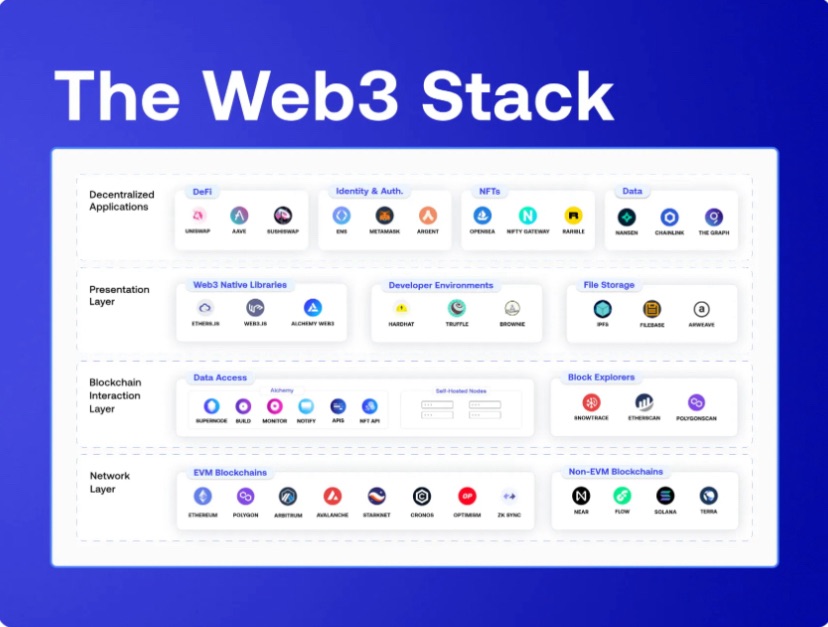
- Design and Technology: Web3 is built on the concept of decentralization, primarily using blockchain technology. This allows for a peer-to-peer interaction model, eliminating central points of control and failure. Technologies central to Web3 include Ethereum, smart contracts, and decentralized applications (dApps) that run on a blockchain. It introduces concepts like cryptocurrency for transactions, and tokens for governance and access control within applications.
- Speed and Efficiency: Web3 technologies, particularly blockchain, face challenges with speed and scalability. Transactions on blockchain networks like Ethereum can be slower and more expensive than traditional web technologies due to the computational work (mining) required to validate transactions. However, solutions like Layer 2 scaling, sharding, and other blockchain innovations are being developed to address these issues.
Key Technologies in Web3
- Blockchain: This is the backbone of Web3, providing a decentralized ledger that records transactions across multiple computers. This ensures transparency and security because records cannot be altered retroactively without consensus across the network.
- Smart Contracts: Programs stored on a blockchain that run when predetermined conditions are met. They are typically used to automate the execution of an agreement so that all participants can be immediately certain of the outcome, without any intermediary’s involvement or time loss.
- Cryptocurrencies: Digital or virtual currencies that use cryptography for security. They are typically built on blockchain technology, providing a secure and decentralized way to manage monetary transactions.
- Decentralized Applications (dApps): These applications operate on a blockchain or peer-to-peer network of computers rather than a single computer, and are outside the purview and control of a single authority.
- Tokenization: The conversion of physical and non-physical assets into digital tokens on a blockchain, facilitating their easy and secure management and exchange.
- Decentralized Finance (DeFi): Financial services, including lending, borrowing, and trading, that operate on public blockchains, primarily Ethereum. DeFi platforms operate without traditional financial intermediaries such as banks or brokers.
- Non-fungible Tokens (NFTs): Unique digital tokens that represent ownership or proof of authenticity of a unique item or piece of content, secured and managed on a blockchain.
- InterPlanetary File System (IPFS): A protocol and peer-to-peer network for storing and sharing data in a distributed file system. IPFS uses content-addressing to uniquely identify each file in a global namespace connecting all computing devices.
- Oracles: Services that provide external data (e.g., temperature, prices of assets, etc.) to smart contracts on the blockchain. Since blockchains cannot access external data directly, oracles are critical for the functioning of many blockchain-based applications.
Security Aspects of Web3
Web3 technologies offer enhanced security features primarily due to their decentralized nature and the use of cryptography, which are fundamental to blockchain technology. Here are some security benefits and potential issues:
- Immutability: Once data has been added to the blockchain, it cannot be altered without consensus, which prevents fraud and unauthorized data modification.
- Cryptography: Extensive use of cryptographic techniques ensures that data is secure and that transactions are authenticated across the network.
- Decentralization: By distributing data across multiple nodes, blockchain reduces the risk of central points of failure, making it more resilient against attacks targeting a single point of entry.
However, there are several security concerns:
- Smart Contract Vulnerabilities: Smart contracts are only as secure as the code they are written with. Bugs in the code can lead to significant security vulnerabilities, which have been exploited in the past.
- Scalability and Performance Issues: As more transactions are performed, the slower and more expensive the network can become. This can lead to network congestion, increasing the time it takes for transactions to be processed.
- Regulatory and Legal Challenges: The decentralized nature of Web3 can complicate compliance with existing legal frameworks and regulations, which can create additional risks for users.
Overall, while Web3 technologies offer promising advancements in security and user agency, they also introduce new challenges and complexities that must be navigated carefully.
Key Differences in Summary
- Control and Ownership: Web1 had content creators and consumers, with content hosted on individual servers. Web2 consolidated control with major companies owning data and content platforms, managing how users interacted with content. Web3 aims to return control and ownership to users through decentralized networks where they can own and monetize their own data and participate directly in governance.
- Interactivity and Participation: Web1 was read-only, Web2 is read-write, and Web3 is read-write-own.
- Infrastructure: From centralized servers (Web1 and Web2) to distributed nodes in a decentralized network (Web3).
Web3’s promise lies in its potential to create more transparent, user-centric online experiences, although it’s still in its developmental stages and facing various technical and adoption hurdles.
 Live Bold !!
Leave a comment